Showing posts with label fiction. Show all posts

Sunday, May 3, 2015

Playing Right Field


Playing Right Field
Willy Welch

Scholastic Inc
New York
2000

In this poem, the school's baseball team is playing on a bright Saturday afternoon and the score is nearly tied. The book's narrator, a lonely young boy, has been sent out to cover right field while the more athletic and popular boys share center field. The boy dreams of making the catch of his life but he knows for sure it won't happen. Suddenly, he hears the crowd roar. A quick look up in the sky, and here comes the ball! When the ball lands in his baseball mitt, the boy can't believe it. And neither can his classmates! 

Noteworthy Features:
  • Illustrations: watercolor drawings
  • Baseball
  • School life
This is a great way to introduce to students how poetry can still tell a story like other fictional books they read. Students, especially boys, will like that the book is about baseball. The book also includes important themes such as anti-bullying and courage.

Links to Classroom Activities:

Thursday, February 19, 2015

Somebody Loves You, Mr. Hatch


Somebody Loves You, Mr. Hatch
Eileen Spinelli

Bradbury Press
New York
1991

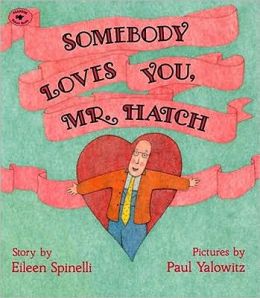
This is the story of cranky man named Mr. Hatch. He did the same routine everyday until one day her received a package from the mailman. After getting the package he becomes a happy man that helps everyone around him. But then the mailman returns with some unfortunate news for Mr. Hatch. The community comes together for him and makes a difference.

Noteworthy Features:
  • The pictures in this book are cartoons. It uses very simple colors. The pictures on each page coincide with the words almost exactly. 
This book is good for students because it shows the impact that feeling loved has on a person. It shows that everyone deserves to be cared for and that we should express our concern and love for others. This book would be cute to use for Valentines Day. The students can write notes to each other expressing a positive message about each of their classmates.

Links to Classroom Activities:


The True Story of the Three Little Pigs


The True Story of the Three Little Pigs
Jon Scieszka

Penguin Group
New York
1989

This picture book tells the story of the three little pigs from the wolf's perspective. The wolf explains that he was framed and really is not the Big Bad Wolf. He was just trying to get some sugar for baking.


Noteworthy Features:
  • It is based off of the well known story of the three little pigs, but told from the perspective of the wolf.
  • The pictures are drawn in a cartoon manner. Some of the words are also written with images. 
This book is funny and students will enjoy it. Teachers can read the story of the three little pigs and then this book and discuss similarities and differences. It could also be fun to have the students defend either the pigs or the wolf and decide which story is "the real" story.

Links to Classroom Activities:

Big Al and Shrimpy


Big Al and Shrimpy
Andrew Clements

Simon And Schuster Books for Young Readers
New York
2002

This picture book is about a little fish named Shrimpy who becomes friends with a big fish named Al. The two do not fit in with the rest of the fish, but when Big Al needs help, Shrimpy comes up with a plan and gets the other fish to help him.

Noteworthy Features:
  • Pictures: The pictures in this book are full pages. The words are on top of the pictures. All the pictures are in natural looking colors of greens and blues. The images are seem textured. There are bumps and lines that give texture to the ocean scenery and to the fish.
This book would be good to use in the classroom to  help with social and emotional development. The teacher can discuss friendship and groups with the students. Because Big Al and Shrimpy are both outcasts it is a good book to discuss social elements with class. Also, Big Al and Shrimpy have emotions that the students can discusses to help aid in the emotional development of students.

 Links for Classroom Activities:

Monday, February 2, 2015

Jumanji


Jumanji
By Chris Van Allsburg

Houghton Mifflin Company
Boston
1981

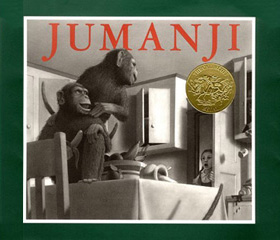
The Caldecott Medal Award winner,"Jumanji," is about two children, Peter and Judy, who were bored at home. They went outside and found a normal looking game under a tree. They decided to try the game when they got home. When they began to play they realized that the game was not a typical game. Everything that happened while playing the game actually happens in real life. Playing this game puts the two children on an unforgettable adventure.

Noteworthy Features:
  • Pictures: This is a pictures book. The pictures are all in black and white. The pictures are very realistic. The pictures look like they have depth rather than being flat on a page. They are also detailed, for example you can see the different pieces of hair on the children's heads and on the monkey's bodies. 
  • Quotes: The book is written so there is a narrator who is not either of the children. When the children are talking it is always quoted. This can introduce to students the concept of quotes, and how quotes show when a person is talking. This can also be used to have the children do a read aloud.

Students who like adventure stories would enjoy reading "Jumanji." Because this is a picture book, it can be beneficial for students who need help visualizing what is happening. The book is also not very long, so it is a good book to read when you want to be able to read an entire story at one time or for students who struggle reading lengthy books.

Links for Classroom Activities:


Friday, January 23, 2015

Things Not Seen


Things Not Seen
By Andrew Clements

Scholastic Inc
New York
2002

Bobby Phillips was a typical fifteen year old boy, until one day he wakes up invisible. His parents try to help him as much as they can, urging him not to tell anyone. He goes to the library and meets a Alicia, a blind girl. Since she cannot see, she is the perfect person to talk to, and they become friends. He is forced to tell her of his situation and she helps him through his struggles. In addition to being invisible, Bobby faces hardships which leave him home alone for a couple days and more hardships when the school calls the Child Protective Services because he has missed three weeks of school. Bobby, Alicia, and both of their parents work to find the cause of Bobby's invisibility.

Noteworthy Features:
  • Conversations: The author includes Instant Message conversations between Bobby and Alicia. These conversations are written with improper grammar, shortened spellings, and little or no punctuation. They are written the way people would actually IM each other. 
  • Blindness: This book addresses the disability of blindness. It can help students understand the struggles a person who is blind may experience. 

Amidst all of the chaos and hardships, Bobby learns about friendship, trust, and taking control of his future. As a teacher this book is good for students to read. It has a storyline that students will enjoy of a boy who becomes invisible. But it also teaches students what it means to be a friend and the difference a friend can make in a persons life. It also focuses on the concept of trust. Bobby keeps his word making him someone to trust. Alicia also keeps Bobby's secret for him making her another example of a trustworthy person. Lastly, another strong concept from this book is taking control of ones future. It is important that students learn to think for themselves and know what they think. Bobby is constantly working towards thinking for himself. Alicia also exhibits this theme. Her story of becoming and living blind, pushed her to see life differently and take control of her future.

Links for Classroom Activities: